Program Booklet
Up Close: Haydn & Dvořák
Wednesday October 28
8:15 p.m.
until approximately 9:30 p.m.
Experience an intimate evening of chamber music by Haydn, Martin, and Dvořák, with dazzling strings, gentle humour and lush lyricism in the Nieuwe Kerk.
📳
Please put your phone on silent and dim the screen so as not to disturb others during the concert. Taking photos is allowed during applause.
Programme
Franz Joseph Haydn(1732–1809)
String Quartet in E-flat major, Op. 33, No. 2, “The Joke” (1781)
Allegro moderato
Scherzo: Allegro
Largo
Presto
Frank Martin(1890–1974)
Pavane couleur du temps (1920)
Antonín Dvořák(1841–1904)
String Sextet in A, Op. 48 (1878–1879)
Allegro – moderato
Dumka: Poco allegretto
Furiant: Presto
Finale: Theme with Variations. Allegretto grazioso, quasi andantino
The concert ends around 9:30 p.m.
What are you going to listen to?
“I have something entirely new in mind, in a special way,” Joseph Haydn wrote in early December 1781 to a respected buyer of his music in Switzerland. During that period, the court composer for the Esterházy family had gained more freedom and was looking for ways to distribute more of his new music on the international market. He often sold manuscripts to individuals before publishing his compositions through publishing houses. This was also the case with his series of six string quartets, Opus 33.
It became a series that was soon nicknamed “gli scherzi.” That nickname had two meanings. First, the minuets from Haydn’s earlier divertimenti for this instrumentation had been replaced by a somewhat faster and lighter movement, called a Scherzo. But Haydn did more than that; he actually incorporated all sorts of little jokes into his music. In particular, the String Quartet in E-flat Major from this collection took the cake, frequently throwing listeners off guard in the “ Last ” movement. Sudden cut-offs, silences that go on far too long. And then the music continues after all. Or does it? Right up to the very end, Haydn plays a game with his audience’s expectations.
Haydn premiered his quartet on Christmas Day in 1781 at the home of the Russian Grand Duke (and later Tsar) Paul I in Vienna, to whom he would dedicate the works. In addition to the nickname “gli scherzi,” they would therefore also become known as the “Russian” quartets.
The Pavane couleur du temps, written in 1920 for string quintet, is a stately, flowing dance by Frank Martin. The Swiss composer, who would later settle in Naarden in the Gooi region, borrowed the title from one of Charles Perrault’s fairy tales, on which Ravel also based his *Ma mère l’oye *. The story *Peau d’âne* is about a stunningly beautiful princess who, to prevent her father from marrying her off, asked for three impossible dresses as a dowry: in the colors of the moon, the sun, and the weather, respectively. The idea of a dress in the color of the weather inspired Martin to compose his string quintet, in which he created a colorful miniature through the shifting roles of the various instruments.
In December 1877, the Prague composer Antonín Dvořák learned that he had been awarded the Austrian State Prize for his Moravian duets. Partly thanks to the enthusiasm of his fellow composer Brahms, Dvořák became increasingly motivated to draw more inspiration from the folk music of his native region. As a result, he wrote, in quick succession, a series of Slavonic Dances for piano, Slavonic Rhapsodies for orchestra, and his String Sextet in A. He had previously written various trios, quartets, and quintets, but a sextet offered a whole new spectrum of musical possibilities. Brahms, who had himself written two works for this ensemble, was full of praise when he saw Dvořák’s manuscript at an early stage.
The Sextet from 1878, which he composed in just two weeks, constantly evokes Slavic folk music. Dvořák, for example, called the second movement a “dumka,” a type of Ukrainian folk song that became particularly popular in the 1870s after the composer Lysenko published a work on the subject and toured giving lectures. In Dvořák’s work, a dumka always balances between nostalgia, optimism, and energy—between light and dark. This is contrasted by a “furiant,” a rousing Bohemian dance with playful accents and a touch of humor. As a tribute to Beethoven—whose portrait hung above the composer’s desk—Dvořák structured the “ Last ” movement as a series of variations. After the theme is introduced by the violist, the variations increase in tempo and virtuosity.
The first performance was a private concert by violinist Joseph Joachim’s renowned ensemble, which also included the sextet in its programs abroad. After a performance in London, a reviewer wrote this glowing review: “We need to get to know Dvořák much better—and quickly!”
Frans Boendermaker
Liever op papier? Download een beknopte printbare versie van dit programma.
Biographies
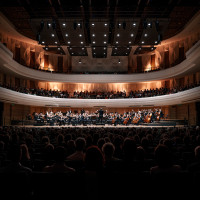
Residentie Orkest The Hague
Fun Fact
Did you know that… Dvořák composed his String Sextet in A in just fourteen days? The work was so enthusiastically received that it marked his international breakthrough in chamber music.



Help The Hague get music!
Support us and help reach and connect all residents of The Hague with our music.

View all program booklets
Be considerate of your neighbors and turn down your screen brightness.