Program Booklet
RO NOW: Le Sacre du printemps
Saturday , May Saturday
8:30 p.m.
until approximately 10:00 p.m.
Let yourself be swept away by Stravinsky’s *The Rite of Spring*: a revolutionary, rhythmic composition and the biggest scandal in classical music history.
This concert is presented in collaboration with Dag in de Branding.
📳
Please put your phone on silent and dim the screen so as not to disturb others during the concert. Taking photos is allowed during applause.
Programme
Willem Jeths (1959)
Piano Concerto No. 3 “Scorching Passions” (2026, world premiere)
· Introduction “The Omen”
· Part I
· Part II
· Part III
Willem Jeths ’ Piano Concerto No. 3 was made possible in part by Performing Arts Fund NL.
Igor Stravinsky (1882–1971)
The Rite of Spring (1911/1913)
· I. The Adoration of the Earth: Introduction – Signs of Spring – Dance of the Young Girls – The Abduction Game – Spring Round Dances – Games of the Rival Cities – Processions of the Sage – Adoration of the Earth (The Sage) – Dance of the Earth
· II. Sacrifice: Introduction – Mysterious Circles of Teenage Girls – Glorification of the Chosen One – Evocation of the Ancestors – Ritual Action of the Ancestors – Sacred Dance (the Chosen One)
End of concert approximately 10 p.m.
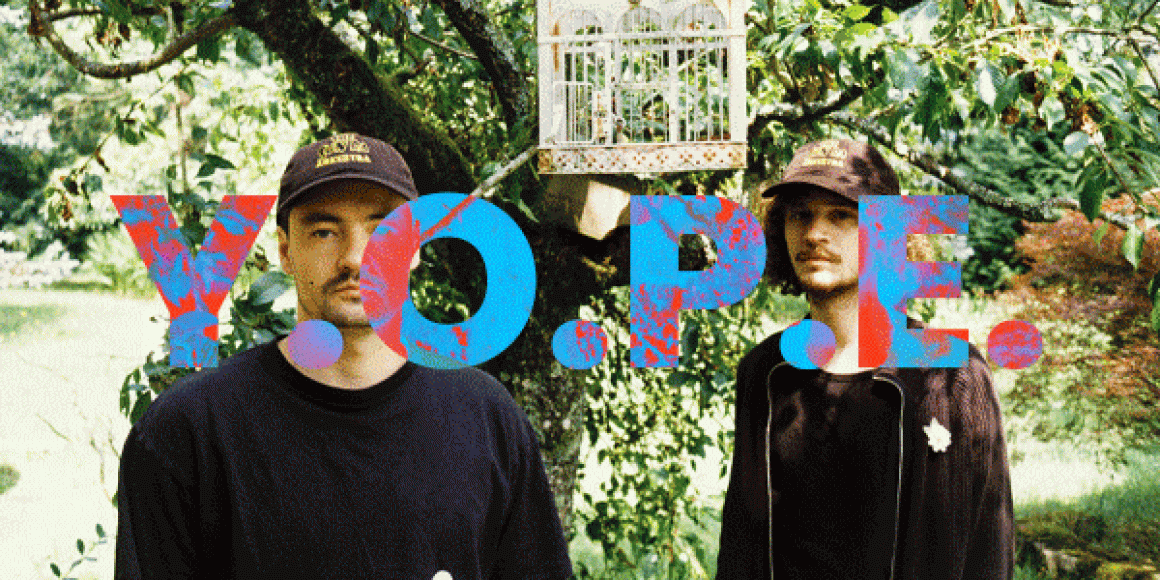
Y.O.P.E.
An unpredictable groove after *The Rite of Spring*
Following the primal energy of *Le Sacre du Printemps*, the evening continues in Foyer 2 with an After Concert by Y.O.P.E.
Just as Igor Stravinsky transformed the orchestra into a pulsating ritual in 1913, Y.O.P.E. operates within that same dynamic today. As bassist and bandleader, The Hague-based Joop de Graaf does not take center stage, but serves as the mastermind behind a collective that moves as one.
Y.O.P.E. is built on a foundation of groove-based beat music. The elements Joop incorporates into this foundation draw from his affinity for futuristic, electronic, and experimental jazz music. It’s a sound that will also take them to the North Sea Jazz Festival this summer.
Just as with *The Rite of Spring*, the power lies not in control, but in surrender: themes appear, disappear, and what happens in between arises in the moment.
If you stick around for a relaxing finale, you’re in for a treat: this isn’t just background music, but an experience that demands your attention—and gives you plenty of energy in return!
Want to relax with a drink after the event? You can do that upstairs in Foyer 3.
Discover the music of Y.O.P.E.
On RO NOW: The Podcast, host Christiaan Kuyvenhoven gives you an exclusive sneak peek at this concert.

Biographies

Residentie Orkest The Hague
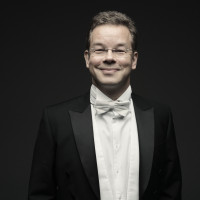
Antony Hermus
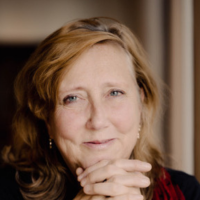
Ellen Corver

Christiaan Kuyvenhoven
What are you going to listen to?
Composer Willem Jeths already had two piano concertos to his credit: his First Piano Concerto from 1994 and his Second, *Fas/Nefas*, from 1997. Over the past year, he has been working on a third. The new piece, titled “Scorching Passions,” is dedicated to soloist Ellen Corver. During the closing concert of the 76th edition of Dag in de Branding , Corver Dag in de Branding premiere the work with the Residentie Orkest the baton of Antony Hermus. Also on the program: Stravinsky’s revolutionary Le Sacre du printemps from 1913. The music was so unprecedented at the time that the premiere resulted in the most famous riot in music history.
World premiere
“It actually started with a chance encounter,” says Willem Jeths. It is mid-March. Over the phone, the composer explains how, nearly thirty years after his Second Piano Concerto “Fas/Nefas” ( 1997), he finally came to compose a third. “I ran into Ellen two years ago in Italy, where we both spend a lot of time. When she asked me if I would write a piano concerto for her, I didn’t have to think twice.”
The fact that he agreed immediately has everything to do with a shared musical history spanning some forty years. When Jeths made a name for himself internationally in the late 1980s with *Novelette* for violin and piano (selected, among other places, for the ISCM World Music Days in Oslo), Corver frequently included the piece in his program with violinist Peter Brunt. Jeths later wrote his piano trio Chiasmos (2000) especially for their Osiris Trio. “I’ve always thought Ellen was a fantastic pianist,” says Jeths. “She can really do anything. She’s very precise rhythmically, but she can also color beautifully, phrase, and create long melodic lines. She’s actually the ideal pianist to write a concerto for.”
Despite his undisputed skills as a soloist, composing his new concerto proved to be quite a challenge. Jeths worked on the piece for a little over a year and a half, a period during which he often wondered what he actually wanted to add to the two piano concertos he had already written.
Ultimately, his Third Piano Concerto became a response to his Second, says Jeths. Whereas *Fas/Nefas* was rife with modernist sound experiments and timbre exercises (the soloist plays with his hands inside the instrument and with sticks on the strings), in *Scorching Passions* Jeths employs a more traditional style of pianism. Jeths: “Just for the black-and-white of the keys. There’s quite a bit of tradition shining through in the solo part. Long lines in the voice leading, a surprising amount of counterpoint. ‘Gosh, this sounds just like Bach,’ Ellen said when we went through the score together recently.”
Thematically, Jeths’ *Derde* is also loosely related to his operas. Just as in *Hôtel de Pekin* (2008), about the Last of China, and *Ritratto* (2020), about the eccentric Italian marquise Luisa Casati, *Scorching Passions* centers on a female figure. Or more precisely: a number of overlapping female archetypes, around which Jeths constructed a richly contrasting triptych on the theme of love (hence the “scorching passions” of the title).
From an early stage, Jeths knew he wanted to do something with Alecto, one of the three Furies from Greek mythology: “That image of an unapproachable, ruthless woman stayed with me. It also resonated strongly with Turandot, another ice queen bent on revenge who initially rejects love.” Jeths was greatly surprised when he discovered that the main motif of Puccini’s Turandot is, in terms of sound, virtually identical to the diminished seventh chord he had already used as the foundation for his concerto in the initial sketching phase. The first movement thus features fragments of the Turandot motif. Meanwhile, the soloist slowly breaks free from the orchestra’s grip: first coaxing, then increasingly assertively resisting, to finally liberate herself with percussive cluster chords. Gradually, Jeths’s female figure transforms. In the second movement, she appears as a dazzling femme fatale who craves adoration. In the final movement, she becomes the embodiment of true love, culminating in an ecstatic union akin to that in Wagner’s *Tristan und Isolde*, in which love and death are inextricably linked. Those who listen closely will hear echoes of the famous Tristan chord.
The biggest brawl in music history
Paris, the evening of Thursday , May Thursday , 1913. In a packed Théâtre du Champs-Elysées on Avenue Montaigne, the audience is eagerly awaiting a new work by Igor Stravinsky, the composer who had already made a name for himself with *The Firebird * and *Petrushka*. Expectations are sky-high. If only because Sergei Diaghilev, impresario of the Ballets Russes, had already stoked the flames in a provocative press release: “A new sensation that will undoubtedly lead to heated discussions.” That turned out to be no exaggeration. As the lights dim and a bassoon begins to play in a shrill high falsetto register, the tension is palpable. During the first few minutes, things remain relatively calm, though the increasing dissonance of the music causes murmurs and whistles here and there. At the start of the second movement, the bomb goes off. Strings and brass blare out an ear-splitting dissonant chord from the orchestra pit, obsessively repeated and punctuated with erratic, off-beat accents. Shouts ring out from the audience boxes. Supporters and opponents even come to blows.
In his acclaimed history of twentieth-century music, *The Rest Is Noise*, New York music critic Alex Ross describes how even Diaghilev was somewhat taken aback when he first heard the passage in question during rehearsals. “Is this going to go on much longer?” he is said to have asked. The composer’s reply: “Until the end, my dear, until the end.” The premiere of *Le Sacre du printemps* would go down in history as the greatest uproar in classical music history. Music would never be the same again. The unprecedented novelty of *Le Sacre* lies primarily in the way Stravinsky (much like Bartók in Hungary and Janáček in the Czech Republic) managed to interweave two seemingly diametrically opposed sonic worlds: modernism and folk music. It was no coincidence that Stravinsky drew upon a wide range of folkloric sources for his new score, ranging from Lithuanian wedding songs and folk dance arrangements by his teacher Rimsky-Korsakov to his own memories of Russian folk songs from his youth. The ingenuity lies in how Stravinsky breaks the material down into small motifs and reassembles them into a cubist-like montage of music full of polytonal harmonies and rhythmic shifts. In doing so, Stravinsky arrived at a new kind of music. As Ross characterizes it: “Streetwise yet refined, cleverly wild, style and muscle-flexing combined.”
Joep Christenhusz
Fun Fact
The Mysterious Bassoon
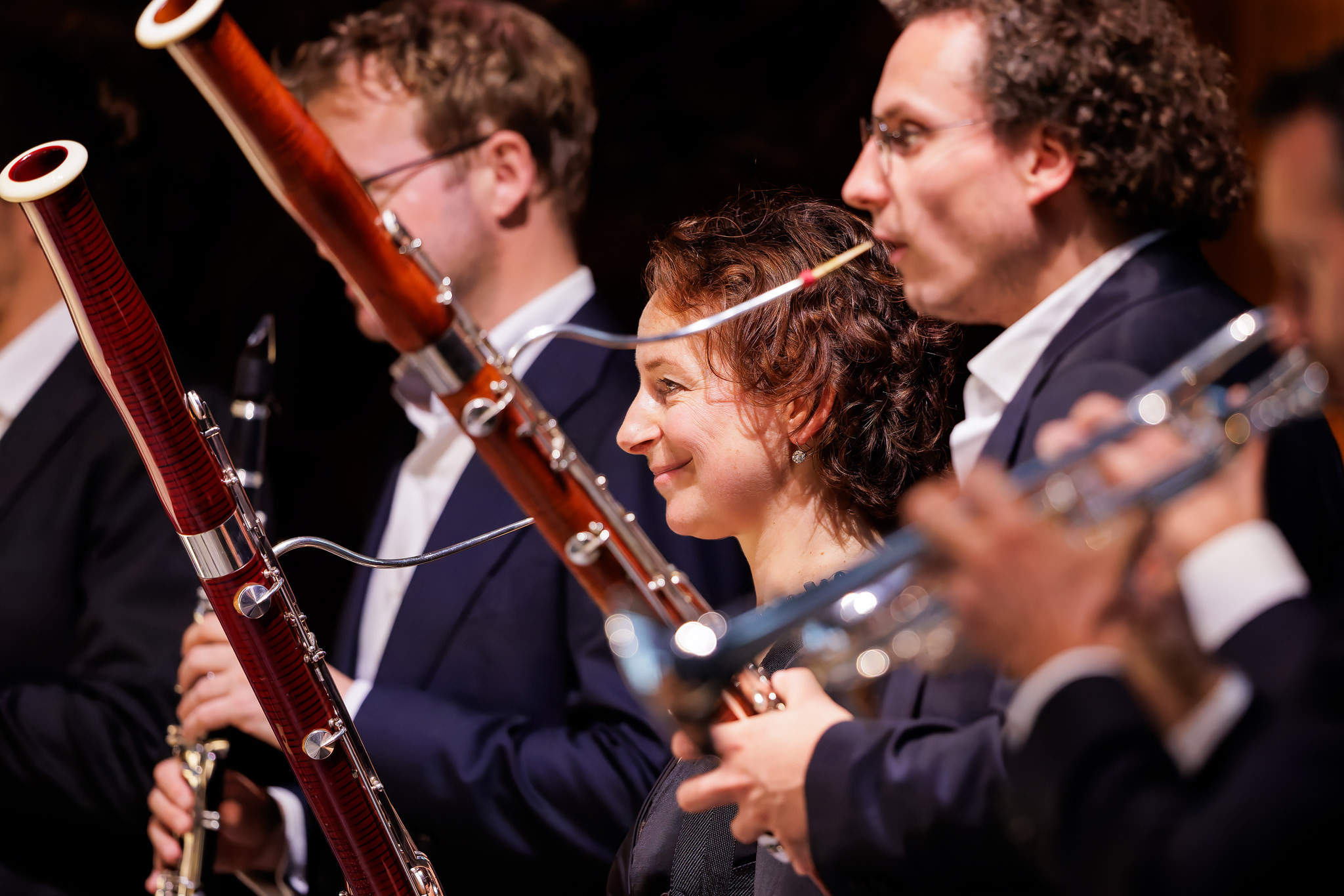
The famous opening passage for the bassoon in *The Rite of Spring* is so high-pitched that many listeners at the premiere did not even recognize which instrument they were hearing. Igor Stravinsky deliberately wrote this part in an extremely high register, making the bassoon sound almost like a strange, unfamiliar instrument—a perfect fit for the ballet’s mysterious, archaic atmosphere.


Help The Hague get music!
Support us and help reach and connect all residents of The Hague with our music.

View all program booklets
Be considerate of your neighbors and turn down your screen brightness.