Program Booklet
A British Evening
Friday , May Friday
8:15 p.m.
to approximately 10:15 p.m.
From Mendelssohn's crashing waves to Handel's fireworks: a journey through British musical history. Egarr conducts an evening full of nature, romance and royal grandeur.
📳
Please put your phone on silent and dim the screen so as not to disturb others during the concert. Taking photos is allowed during applause.
Programme
Felix Mendelssohn Bartholdy(1809–1847)
Overture “The Hebrides,” Op. 26(1830)
Ralph Vaughan Williams (1872–1958)
Suite for Viola and Orchestra(1933–1934)
Group I: Prelude – Carol – Christmas Dance
Group II: Ballad – Moto perpetuo
Group III: Musette – Melancholic Polka – Galop
George Frideric Handel (1685–1759)
From *Water Music* (1717)
Allegro (Suite No. 2 in D, HWV 349)
Alla Hornpipe (Suite in D)
Allegro moderato (Suite No. 1 in F, HWV 348)
Allegro (Suite in F)
Air (Suite in F)
Minuet (Suite in F)
Sarabande (Suite No. 3 in G, HWV 350)
Minuet (Suite in G)
Minuet (Suite in F)
Lentement (Suite in F)
Bourrée (Suite in F)
George Frideric Handel (1685–1759)
Music for the Royal Fireworks, HWV 351(1749)
Overture (Adagio – Allegro – Lentement – Allegro)
Bourrée
La Paix (Largo alla siciliana)
La Réjouissance (Allegro)
Minuet I
Minuet II
End of concert approximately 10:15 p.m.
What are you going to listen to?
The Residentie Orkest tribute to British sounds in a rich and inspiring program.
Serene landscapes with rugged cliffs, occasionally featuring a waterfall, a ruin, or a small townscape. Anyone viewingFelix Mendelssohn’sfluid yet exquisitely precise drawings and watercolors online immediately gets a sense of the journey the twenty-year-old composer undertook through England and Scotland in 1829. A trip abroad was, alongside the visual arts, music, philosophy, and literature, a natural part of the cultural upbringing of the Mendelssohns. Mendelssohn was introduced to the poetic verses of Ossian—the mythical, blind bard said to have lived in a cave (Fingal’s Cave) on one of the Hebrides islands off the Scottish west coast—from an early age. The actual visit to the cave, with its unique acoustics of waves and wind, must have made a deep impression on the composer. Despite his seasickness.
In the initial sketches of theoverture “The Hebrides”that Mendelssohn made during this journey, ancient melodies emerge from the rolling sea as if rising from the mist. The undulating rhythm of the music remains palpable throughout the piece, ranging from tranquil recollection to a romanticized sea storm. Although the musical composition was refined over many years, it gives the impression of a quick, striking watercolor sketch, drawn on the spot.
It took a long time for the British public to recognize the value of its own musical culture. In the early twentieth century, several composers, includingRalph Vaughan Williams, set out to explore the English countryside. His compositions capture the atmosphere of rural life or incorporate specific folk melodies, such as the popular“Greensleeves,” which he recorded during his fieldwork.
He had a particular fondness for the viola, an instrument he also played himself. He wrote hisSuite for Violaand Orchestrafor the violist Lionel Tertis, who gave the premiere performance in 1934. The suite consists of eight miniatures, each with its own distinct atmosphere, which can also be performed separately. Vaughan Williams drew inspiration from the pastoral atmosphere of Baroque works such as Handel’sMessiah ora simple folk carol. In the more introspective Ballad, a pentatonic melody resounds, as in much traditional folk music, accompanied by a bagpipe-like accompaniment in parallel fifths. The third group of miniatures centers on several folk dances, with occasional deeply personal glimpses into the British soul.
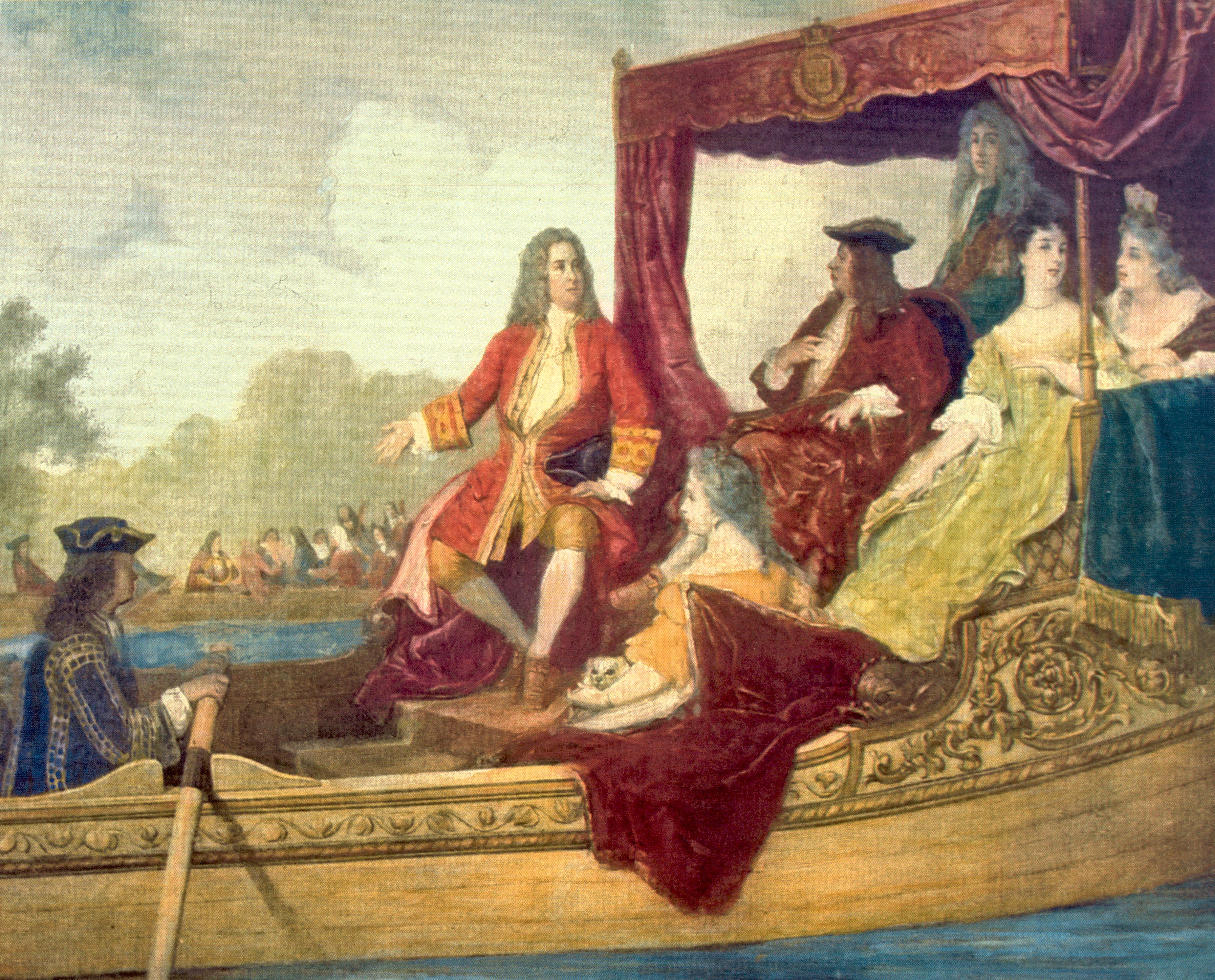
In the eighteenth century, the British public loved grand events, and the royal family, too, could not be extravagant enough. In the summer of 1717, King George I organized a boat procession on the Thames.*The Daily Courant*reported: “There were so many boats that the entire river was covered. (…) One of them was dedicated to music, with as many as fifty instruments of all kinds, which played the most beautiful symphonies along the entire route from Lambeth Palace, composed especially for this occasion by Mr. Handel. It so delighted His Majesty that he instructed the musicians to play the whole piece three times over.” This music byGeorge Frideric Handel, which lasts about an hour in total, has become known asWater Music. The composer, originally from Saxony, Germany, had been working in London since 1712 and eventually became an official British citizen.
In 1749, London was once again the scene of grand festivities, this time to celebrate the Peace of Aachen, which a year earlier had sealed the end of the War of the Austrian Succession. King George II commissioned a spectacular fireworks display on the Thames, for which the Italian artist and set designer for the Paris Opera, Giovanni Niccolò Servandoni, created a magnificent commemorative set. Amidst this setting, a large military orchestra performed, featuring no fewer than 24 oboes, 12 bassoons, contrabassoon, a serpent, 9 trumpets, 9 horns, 6 timpani, and percussion. Handel composed his*Music for the Royal Fireworks* especially for this occasion.
After a festive overture in the French style, 101 cannon salutes rang out, and the fireworks display began. The dances *La Paix* and *La Réjouissance* explicitly refer to the aforementioned peace treaty. Something always went wrong at such events. Due to the strong wind, a firework landed in the scenery, causing a fire and resulting in two casualties. Servandoni lashed out furiously at a staff member in charge and threw a sword at his head. The famous artist had to spend the rest of the night in jail. It did not damage the reputation of Handel’s music. The composer later revised the orchestration to include a string orchestra and a more modest wind section so that the musical subtleties would come into their own, and in this version, the music remains particularly beloved at concerts and special ceremonies.
Frans Boendermaker
Prefer it on paper? Download a condensed printable version of this program.
Biographies

Residentie Orkest The Hague

Richard Egarr
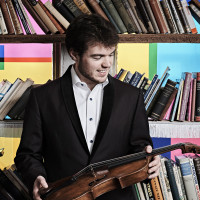
Timothy Ridout
Fun Fact
Handel wrote his*Water Music*to be strikingly loud, and that was intentional. Since the music was performed on the river, everyone had to be able to hear it clearly above the sound of the water and people talking. That is why Handel used many horns and trumpets. Strings alone would likely have been “drowned out” by the ambient noise, so Handel was essentially thinking like a sound designer avant la lettre.
King George I and Handel on the Thames, an impression of the first performance of Water Music.
RO QUIZ
Who painted The Hague's Groenmarkt?-
George Frideric Handel
Answer: Felix Mendelssohn
Felix Mendelssohn was not only a composer but also a gifted painter who loved to capture scenes from nature. He also liked to travel and visited The Hague and Scheveningen in 1836. Unfortunately, he did not write a Hague symphony or overture here, but he did make drawings of the Kleine Groenmarkt, among other places.
-
Ralph Vaughan Williams
Answer: Felix Mendelssohn
Felix Mendelssohn was not only a composer but also a gifted painter who loved to capture scenes from nature. He also liked to travel and visited The Hague and Scheveningen in 1836. Unfortunately, he did not write a Hague symphony or overture here, but he did make drawings of the Kleine Groenmarkt, among other places.
-
Felix Mendelssohn
Answer: Felix Mendelssohn
Felix Mendelssohn was not only a composer but also a gifted painter who loved to capture scenes from nature. He also liked to travel and visited The Hague and Scheveningen in 1836. Unfortunately, he did not write a Hague symphony or overture here, but he did make drawings of the Kleine Groenmarkt, among other places.

Answer: Felix Mendelssohn
Felix Mendelssohn was not only a composer but also a gifted painter who loved to capture scenes from nature. He also liked to travel and visited The Hague and Scheveningen in 1836. Unfortunately, he did not write a Hague symphony or overture here, but he did make drawings of the Kleine Groenmarkt, among other places.


Help The Hague get music!
Support us and help reach and connect all residents of The Hague with our music.

View all program booklets
Be considerate of your neighbors and turn down your screen brightness.