Program Booklet
Classics at the Nieuwe Kerk
Saturday September 26
8:15 p.m.
until approximately 10:00 p.m.
This evening is bursting with vitality, color, and new discoveries: Prokofiev’s playful “Classical,” Spohr’s melodious Violin Concerto, and Sibelius’s mysterious *Pelléas et Mélisande*.
📳
Please put your phone on silent and dim the screen so as not to disturb others during the concert. Taking photos is allowed during applause.
Programme
Sergei Prokofiev(1891–1953)
Symphony No. 1, Op. 25 “The Classical” (1916–1917)
Allegro con brio
Larghetto
Gavotte: Not too fast
Finale: Molto vivace
Louis Spohr(1784–1859) |
Violin Concerto No. 8 in A minor, Op. 47, “in modo di scena cantante” (1816)
Allegro molto (recitative)
Adagio; Andante
Allegro moderato
Jean Sibelius(1865–1957)
Pelléas et Mélisande, Op. 46 (1904–1905)
In front of the castle gate
Mélisande
On the coast
A fountain in the park
The Three Blind Sisters
Pastoral
Mélisande at the spinning wheel
Intermission
The Death of Mélisande
The concert ends around 10:00 p.m.
What are you going to listen to?
Right between the February Revolution and the October Revolution in 1917, Sergei Prokofiev sought peace and quiet in a country house outside what is now St. Petersburg. A beautiful garden, flowers, blue skies, sunshine, silence—far from the attacks, bombs, and gunfire in the city. The only thing missing was a piano, but that didn’t matter. The Russian pianist had learned at the conservatory how Haydn composed, and he now wanted to experience the benefits of that approach for himself. “Until then, I had always composed at the piano, but now I noticed that the thematic material conceived without a piano was often much better… I toyed with the idea of writing an entire symphony without using the piano, thinking that such a piece would have much more natural and transparent colors,” Prokofiev later wrote in his autobiography. Just as Russia deposed (and executed) its tsar, a piece emerged in the spirit of the old 18th-century aristocratic salons: his Classical Symphony.
Featuring a classical orchestral lineup, the symphony opens with a characteristic gesture from the 18th-century orchestral tradition: the so-called “Mannheim rocket,” which soars to a high D. Prokofiev blends elements from gallant court dances, such as the gavotte, with surprising modulations, unusual chords, and ethereal melodies featuring wide leaps. At the beginning of the Finale, Prokofiev rouses the audience with a “premier coup d’archet”—another typical, classic Mannheim trick. Full of musical jokes, sudden dynamic shifts, and without a single minor chord, the orchestra thunders onward.
And with that, Prokofiev set out to compose a symphony the way Haydn might have done had he been alive in 1917. Or, as Prokofiev put it: “First, for its simplicity, and second, for fun—a bit provocatively and with the secret hope… that it might one day become a true classic.”
A century earlier, when Louis Spohr stopped in Switzerland with his family on their way to Italy in 1816, he composed his Eighth Violin Concerto. Anyone who reads the German composer and violinist’s entertaining autobiography will discover how Spohr conquered mountain passes on foot or by h paard , sometimes in harsh weather conditions; how he had to organize his own small concerts along the way; and how, during stopovers, he listened to performances by musicians who were sometimes cringe-inducingly bad.
Tonight’s violin concerto took the form of a vocal scene. The composer must have known that south of the Alps there was a tremendous craze for opera and that this form would certainly catch on there. At the premiere in Milan, Spohr—who stood nearly two meters tall—played the virtuoso solo part himself. Like an operatic recitative, the violin soloist introduces the unfolding drama, which, much to the delight of the Milanese, unfolds into a wordless narrative through a series of melodious arias.
Later during this Italian tour, Spohr also met Paganini, with whom he was sometimes compared. Spohr would play at least as important a role in the development of violin playing, not only because of his many demanding compositions, but also as the author of a violin method and the inventor of the chin rest.
The Symbolist Play Pelléas et Mélisande by Maurice Maeterlinck, written in 1893, was a remarkably common source of inspiration for composers. Debussy based his only opera on the fairy tale, but Fauré, Schönberg, and Sibelius also wrote music to accompany the story. In 1904, Jean Sibelius was commissioned by the Swedish Theater in Helsinki to compose so-called incidental music—background music played during scene changes. Whereas Debussy, in his opera *Pelléas et Mélisande* , placed strong musical emphasis on the story’s sultry, erotic undertones, Sibelius opted for a more traditional, tragic interpretation.
The music follows the chronology of the story. In a fictional land, Prince Golaud meets a shy girl by a forest stream. She has lost her crown but doesn’t dare to retrieve it from the water. Golaud takes her to his castle and marries her. Accompanied by a melancholic alto oboe solo, the girl—Mélisande—is introduced, seemingly unhappy in her marriage. The coast is cold, bleak, and gray, but the tide turns when, on a cheerful spring day by a fountain, she meets Pelléas, her husband’s brother. Their forbidden love is immediately intense and sparkling. Mélisande then sings a hopeful song by Maeterlinck about three blind sisters.
Even in the countryside, spring is in the air and the couple’s intense love is palpable (Pastorale), but when Mélisande sits at her spinning wheel, she breaks out in a cold sweat. What if Golaud discovers her relationship with Pélleas? The same sense of agitation can be heard in the long musical interlude. And indeed: Golaud catches the couple, kills his brother, and wounds Mélisande. Later, she dies tragically while giving birth to a daughter. The poignant music fades away with a slow morendo.
Frans Boendermaker
Prefer it on paper? Download a condensed printable version of this program.
Biographies

Residentie Orkest The Hague
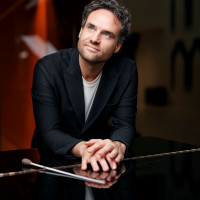
Leonard Elsenbroich
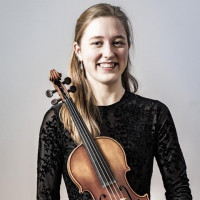
Salomé Bonnema

Help The Hague get music!
Support us and help reach and connect all residents of The Hague with our music.

View all program booklets
Be considerate of your neighbors and turn down your screen brightness.