Program Booklet
Pärt & Tavener
Saturday , May Saturday
8:15 p.m.
to approximately 10:15 p.m.
A musical experience for the soul, full of meditative beauty and tranquility.
📳
Please put your phone on silent and dim the screen so as not to disturb others during the concert. Taking photos is allowed during applause.
Programme
Arvo Pärt(1935)
Fratres for strings and percussion(1977/1991)
Astor Piazzolla(1921–1992)
Milonga del Ángel(1962, arr. Matthew Barley)
Arvo Pärt(1935)
Festina lente(1990)
Milton Nascimento(1942)
Um Girassol Da Cor De Seu Cabelo(1982, arr. Matthew Barley)
John Tavener(1944–2013)
The Protecting Veil, for cello and string orchestra(1988)
The Protecting Veil
The Nativity of the Mother of God
The Annunciation
The Incarnation
The Lament of the Mother of God at the Cross
The Resurrection
The Dormition
The Protecting Veil
The concert ends around 10:30 p.m.
What are you going to listen to?
Pärt and Taverner, two composers who dare to strip minimal music down to its very essence. As devout believers, they seek to elevate listeners to a higher dimension of religious experience through their music. That is why they are known as the “holy minimalists.”
Bells
The Estonian composerArvo Pärtbegan his career as a rebellious avant-gardist with works that excelled in twelve-tone music, serialism, and other atonal compositional techniques. But over time, he changed his style. Complicated bursts of sound gave way to music consisting of extremely simple harmonies in which repetition played a major role. He embraced minimal music and went even further, reducing his music to a few lines and harmonies that evoked a mystical experience through their subtle repetition. He called this technique “Tintinnabuli,” Latin for “little bells.” Fratres,oneof the first works in this style, consists of only two simple melodic lines set against a harmonic triad. Subtle shifts in these three elements create a series of nine variations. Pärt did not specify any particular instrumentation for this music. For him, the musical building blocks were more important than the timbre. As a result, a large number of versions of this piece have been released.
Festina lente(hurry slowly) is the title of another tintinnabuli composition by Pärt. He takes the contrast between “hurry” and “slowly” literally. Using the notes of a simple scale, he creates a melody that can be heard simultaneously in three parts at normal speed, half speed, and double speed. To resolve this, the normal and fast versions are repeated a few times to keep pace with the slow version. Eventually, all three parts fade away into nothingness.
Veil of the Mother of God
Just as with Pärt, religion plays a very significant role inJohn Tavener’slife and musical expression. He was initially drawn to Catholicism but later converted to the Eastern Orthodox Church. Musically, he was fascinated by the simplicity of Orthodox music and the great expressiveness it conveyed. Initially, he incorporated that inspiration into much of his choral music, combining, much like Pärt, simplicity and modern compositional techniques into a soothing style. In 1987, with*The Protecting Veil*, he composed purely instrumental music againforthe first time. It draws on an important feast within the Orthodox churches: the Protecting Veil of the Mother of God. It is a well-known depiction often found on icons, in which Mary spreads her protective mantle over the faithful. In his own words, Tavener sought to capture this icon in music, with the solo cello representing Mary, embedded in the sounds of a string orchestra. He also broadens the scope of his composition by incorporating other scenes from Mary’s life. As a foundation, the composer uses a number of harmonic tone sequences that he processes using medieval polyphonic techniques, such as augmentations, diminutions, inverted or backward sequences, all interconnected in various canons. In doing so, he does not shy away from modern sounds. The sequences and their variations can sometimes clash quite sharply and even produce clusters of notes. This brings tension and release to the music, but because it remains based on harmonious melodies, the overall sound stays gentle and meditative. And that is precisely the intention. The listener is drawn into the emotions of Mary’s life, but these are never so intense that the music’s religious character is lost.
Tango and Saudade
As an “intermezzo,” this program features, in addition to improvisations linked to Matthew Barley’s own program, two short works that—with a little imagination—echo the spirit of the holy minimalists. According toAstor Piazzolla, the tango is both devilish and heavenly. “We are all both God and the devil at the same time,” was his conviction. He wrote a series of devil tangos, but also a set of angel tangos, of whichMilonga del Ángelistheoldest. It was later incorporated into AlbertoRodríguez’splayTango del Angel, in which an angel shines his light over the slums of Buenos Aires.
Milton Nascimentois a Brazilian singer-songwriter who has been active since 1962. For several years, he played with the collectiveClube da Esquina, with whom he released a double album in 1972. One of the best-known songs from that album is“Um Girassol Da Cor De Seu Cabelo”(A Sunflower the Color of Your Hair). It is a song of melancholy and quiet longing, “saudade” as they call it in Portugal and Brazil.
Kees Wisse
Prefer it on paper? Download a condensed printable version of this program.
Biographies

Residentie Orkest The Hague
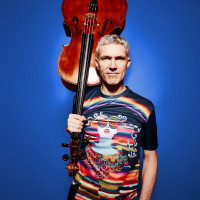
Matthew Barley



Help The Hague get music!
Support us and help reach and connect all residents of The Hague with our music.

View all program booklets
Be considerate of your neighbors and turn down your screen brightness.