Grandmaster Dennis Russell Davies makes his debut with the Residentie Orkest
-1790761938.webp/b6b2343298b38f49235da804afcc8859.webp)
Unconventional, groundbreaking, and a tireless advocate of new music for more than half a century. American conductor and pianist Dennis Russell Davies (1944) is one of the great adventurers of the international music world.
He has conducted the Berlin Philharmonic, the Concertgebouw Orchestra, and the major American orchestras; worked closely with composers such as John Cage, Arvo Pärt, and Luciano Berio; and played a crucial role in the development of Philip Glass’s symphonic works. On October 2, he will make his debut with the Residentie Orkest.
Davies studied at the renowned Juilliard School in New York and began his career in the United States, where he conducted, among others, the Saint Paul Chamber Orchestra, the American Composers Orchestra, and the Brooklyn Philharmonic. Starting in 1980, he also built an impressive career in Europe, holding chief conductor positions at institutions including the Stuttgart State Opera, the Vienna Radio Symphony Orchestra, the Bruckner Orchestra Linz, and the Basel Symphony Orchestra. Since 2018, he has been chief conductor and artistic director of the Brno Philharmonic. Along the way, he has conducted virtually everywhere that matters: from Berlin, Milan, and Leipzig to Chicago, Boston, and New York.
Tchaikovsky
Studying hard at the prestigious Juilliard School in New York and penetrating finals of such international violin competitions as the Queen Elizabeth Competition and the Tchaikovsky International Competition, among others, did transform that initial, strange sound. Now praised for her virtuosity, clarity and warm and rich tone, Kim knows how to take the most famous violin concertos to unprecedented levels. But Tchaikovsky's Violin Concerto holds a special place in her heart: "This was the first concerto I wanted to perform with an orchestra, which eventually led me to pursue a career as a soloist. Tchaikovsky's extraordinary ability to create melodies is second to none, and the way the soloist interacts with the orchestra in this concerto is incredibly satisfying. It is challenging to put into words, but the emotional depth in his music creates a deep sense of catharsis when I play it. With each performance, I experience a greater and greater sense of freedom and am able to express myself even more fully through his music."
The Man Behind Glass's Symphonies
Still, a list of famous orchestras tells only part of the story. Perhaps what is most remarkable about Davies is that he was never satisfied with the existing repertoire. Throughout his career, he actively sought out composers, commissioned new works, and introduced music to the “ Concert Hall ” that has since become an integral part of it. Names such as Aaron Copland, John Cage, Laurie Anderson, Luciano Berio, and Philip Glass run like a common thread through his musical life.
An exceptional collaboration developed with Glass. Davies has been conducting his music for decades, premiered numerous works, and strongly encouraged the composer to write for symphony orchestra. That “ Last ” had far-reaching consequences. Glass himself later said that he initially wrote symphonies because Davies asked him to. Among other things, Davies was the catalyst for Glass’s First Symphony, based on David Bowie and Brian Eno’s album *Low*, and subsequently became one of the most important advocates of Glass’s symphonic music. In the context of Glass’s Tenth Symphony, Davies is even described as the catalyst and champion of his entire symphonic oeuvre, having commissioned nine of the first ten symphonies.
-1790761996.webp/e4855eb9ac07c91618b705aa99aceaa7.webp)
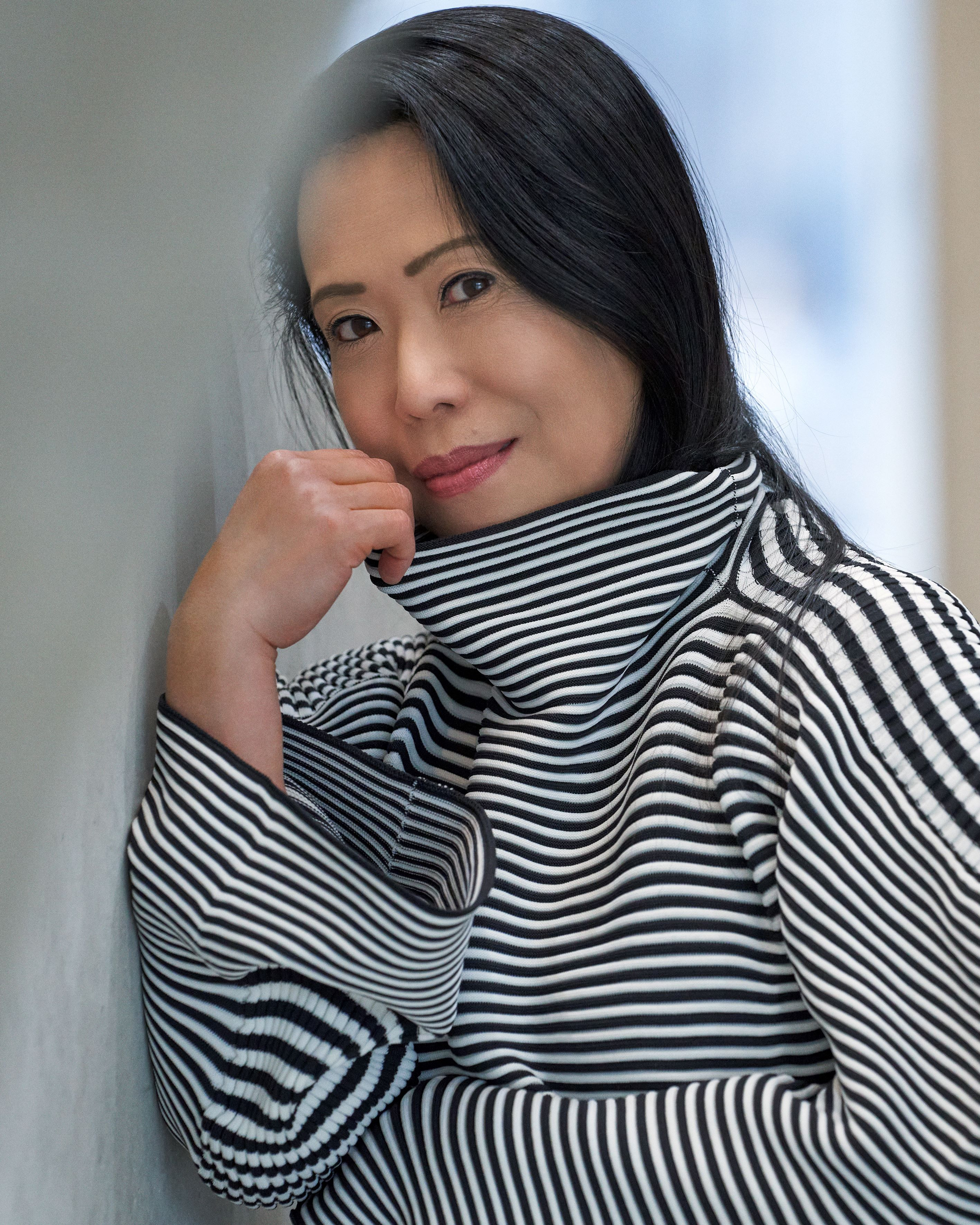
Davies now shares this long-standing connection with Glass with his wife, pianist Maki Namekawa. Together, they have formed a piano duo since 2003, and Glass wrote his *Four Movements for Two Pianos*, among other works, for them. Namekawa has also become a leading interpreter of Glass’s piano music. For *Mishima*, she had the entire film score arranged for piano by Glass’s longtime musical collaborator Michael Riesman; in 2018, she released that version and performed its premiere. A year later, Glass also wrote his first piano sonata specifically for her: *
* On October 2, at the Friday , these threads will converge in The Hague. Davies will conduct the Dutch premiere of Glass’s *Mishima Concerto*, based on the music for Paul Schrader’s film *Mishima: A Life in Four Chapters*, with Namekawa at the piano. The concerto was also arranged by Michael Riesman and was commissioned in part by Dennis Russell Davies and the Residentie Orkest. The world premiere took place in 2023 with Namekawa as soloist and Davies as conductor.
From Glass to Rachmaninoff
Anyone who associates Davies solely with contemporary music is, incidentally, doing him a disservice. His repertoire ranges from pre-Baroque music to the latest compositions, and it is precisely this ability to move between worlds that is one of his hallmarks. That is why, alongside Glass, Rachmaninoff’s Third Symphony will be performed on October 2: music full of rich colors, melancholy, and longing. A completely different universe, but not a contradiction in Davies’s world.
This makes his first encounter with the Residentie Orkest immediately significant: a conductor who, throughout his career, has placed new music alongside the great symphonic repertoire, with a composer whose orchestral music he himself helped put on the map.